



What Are Concrete Blocks Used For?
Concrete blocks are the workhorse of Australian masonry. They turn up in everything from suburban shed bases and boundary walls around Brisbane through to load-bearing walls in commercial fitouts across Sydney's industrial estates. The category covers solid blocks, hollow blocks, breeze blocks, coloured architectural blocks and a range of specialty units, but they all share the same basic role: a precast, dimensionally consistent masonry unit that lays faster than brick, carries heavier loads, and performs particularly well in retaining walls, structural cores and any wall where performance matters more than appearance. Concrete blocks Australia-wide are manufactured to AS 4455, with strength and finish graded for the application.
Structural and non-structural applications
The first decision when specifying a concrete block is whether the wall is structural or non-structural. Structural blockwork carries vertical load: house piers, retaining walls, garage and shed walls, lower courses of two-storey homes. It usually needs core filling with concrete and vertical reinforcement steel designed to AS 3700, the Australian Standard for masonry structures. Non-structural blockwork sits between supporting elements without taking load, boundary walls, infill panels, internal partitions and render-finished feature walls. The same physical block can do either job; what changes is the reinforcement, the mortar grade and whether the cores are filled. Settling structural vs non structural blocks upfront affects the engineer's design, the council process, and the order quantity.
Types of Concrete Masonry Blocks
Concrete masonry blocks are available in a wide range of sizes and formats to suit different building applications, from structural walls and retaining walls through to fences, garages, garden walls and architectural features.
Standard concrete masonry blocks are the most commonly used blocks in residential, commercial and industrial construction. Most standard blocks are based around a 400mm long x 200mm high face size, with different widths available depending on the wall type, strength requirements and finish. Common block widths include 100mm, 150mm, 200mm and 300mm.
Common uses include external walls, internal walls, boundary walls, retaining walls, garages, sheds and structural blockwork.
-

Solid blocks
Solid concrete blocks are heavier and denser than hollow core blocks, making them suitable for areas where strength, durability, fire resistance or acoustic performance is important.
Common applications include party walls, fire-rated walls, acoustic walls and heavy-duty construction.
-

H blocks
H blocks are a standard block format commonly used in reinforced blockwork. Their shape allows steel reinforcement and concrete core fill to be placed through the wall, helping create strong, stable masonry structures.
They are often used in retaining walls, structural walls and other reinforced blockwork applications.
-

Part-size blocks
Part-size blocks are used to help finish blockwork neatly and reduce the need for on-site cutting. These include half blocks, half-height blocks, corner return blocks, control joint blocks and other purpose-made formats.
They help builders maintain clean corners, ends, openings, joints and wall details.


The Brands We Supply








Concrete Block Sizes and Weights
The standard Australian concrete block is 390 × 190 × 190mm, often called a "200 series" block (referring to its nominal 200mm coursing height once the 10mm mortar joint is added). This is the format you'll find across most Besser ranges from Adbri, Austral Masonry and National Masonry. A standard 200 series hollow block weighs roughly 15–18kg depending on density, which is a meaningful factor on big jobs. Block sizes Australia-wide stay close to this baseline, with variations in width and height for narrower walls, half-height closures and bond-beam coursing.
Standard Block Dimensions
The most common formats stocked across Australian sites are:
- 390 × 190 × 190mm: 200 series, the workhorse for both structural and non-structural walls.
- 390 × 90 × 190mm: 100 series, a narrower block used for non-load-bearing partitions and feature walls.
- 390 × 140 × 190mm: 150 series, used where wall thickness sits between 100 and 200mm.
- 390 × 190 × 90mm: half-height blocks, used for closing courses and matching brick coursing.
You'll also see half-length blocks (190mm long) for finishing course ends, bond-beam blocks with channels cast in for horizontal reinforcement, and knockout blocks where vertical bars need to drop through cleanly.
Handling and access
Concrete blocks are heavy, and that drives most of the on-site logistics. A pallet of 200 series hollow blocks weighs roughly 1.2 to 1.5 tonnes, with around 70 to 80 blocks per pallet depending on the manufacturer. Larger orders are delivered on flatbed trucks with crane (HIAB) unloading, which needs swing clearance for the boom and a hard, level area to set pallets down. Sites with steep driveways, overhead power, soft ground or long carry distances should flag access details when ordering. For smaller DIY quantities, single-block handling is manageable but slow, most blocklayers use a block trolley once the wall layout is set.
Common Uses for Concrete Blocks
Concrete blocks turn up across almost every category of construction, but two uses dominate the volume we ship across the east coast: retaining walls and the structural walls of sheds, garages and outbuildings. Each comes with its own block selection, reinforcement specification and council process.
-

Load Bearing & Non-Load Bearing Walls
Concrete blocks are a go-to choice for both load bearing structural walls — such as garage and shed walls — and non-load bearing applications like dividing walls, fences, and garden enclosures. Core-filled 200 series blocks meet most residential structural requirements, offering the strength and dimensional consistency needed whether the wall is carrying a roof or simply defining a boundary.
-

Landscaping Applications
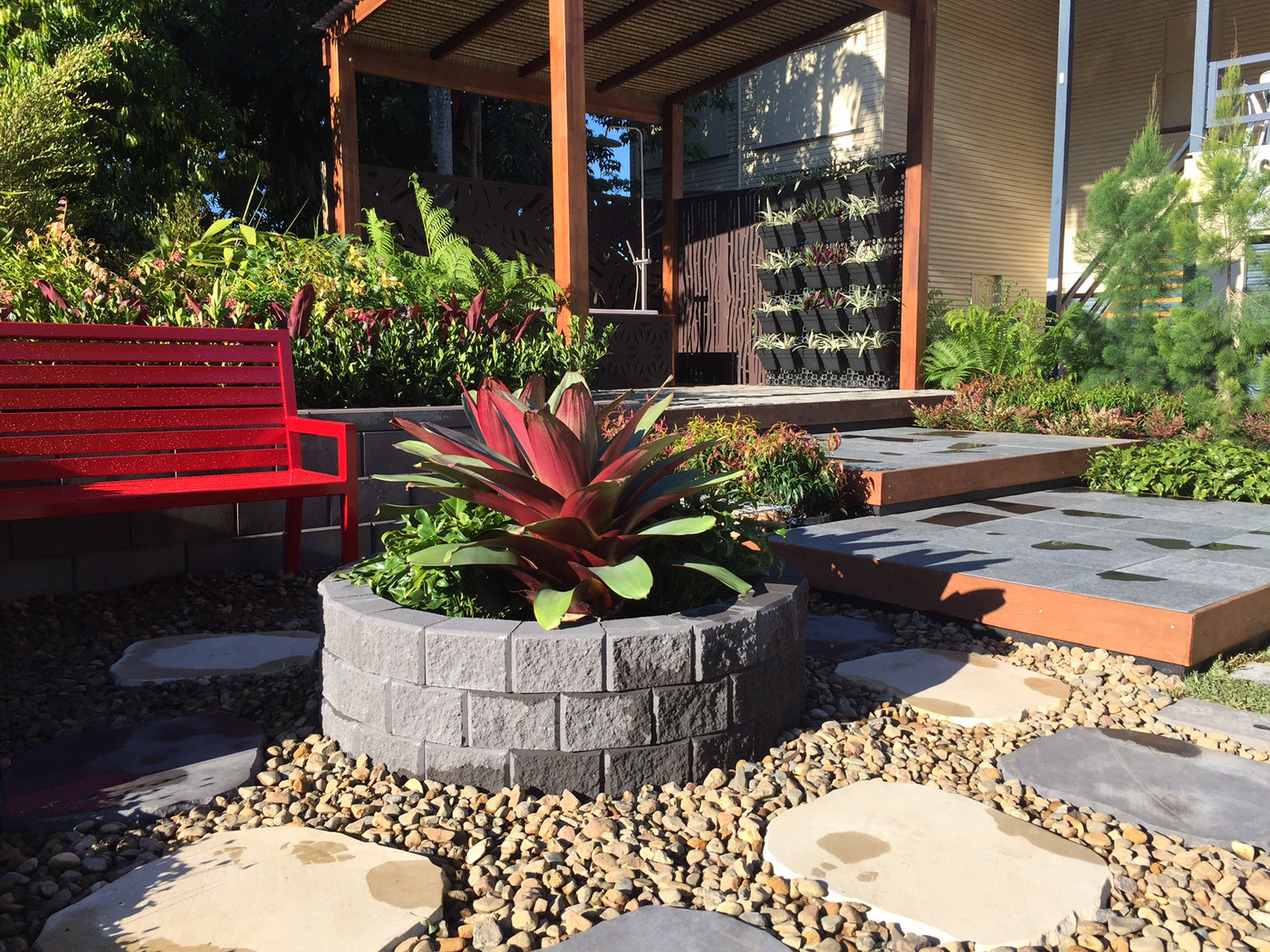
Concrete blocks for retaining walls are one of the most common applications we supply across south-east Queensland and northern NSW. Knowing how to build a block retaining wall starts with the right hollow block, core-filled with concrete and vertical reinforcement bars tied into a stable footing, our retaining wall range covers the engineered systems that match AS 4678.
-

Sheds, fences and foundations
Single-skin block walls are a standard choice for garage walls, large garden sheds, dividing walls between properties, and footings beneath timber-framed structures. Core-filled 200 series blocks meet most residential structural requirements, and their dimensional consistency makes them faster to lay than the rendered brick walls they often replace.


When Blocks Are Better Than Bricks
Blocks and bricks are often interchangeable on paper but rarely interchangeable on site. Most builders across Brisbane, the Gold Coast and Sydney already know when to reach for one or the other, and the decision usually comes down to wall height, load, finish quality and time on the job. The besser blocks vs bricks question comes up most often on shed walls, retaining structures and rendered feature walls, situations where blockwork generally finishes faster and at lower total cost.
Strength, speed and cost
A standard 200 series block covers roughly the same wall area as five standard bricks, and lays with one mortar joint instead of five. On a clean, repetitive wall that doesn't need a finished face, a shed, a garage, a render-and-paint feature wall, that single difference can roughly halve the labour cost compared to brickwork. Blocks also outperform brick on compressive strength once core-filled, which is why most residential retaining walls above 600mm and almost all structural piers use blockwork rather than brick. The trade-off is appearance: standard blockwork doesn't carry the warmth or texture of a face brick wall, so brick still wins where the wall is the design feature.

Architectural and specialty blocks
Architectural and specialty blocks are used where appearance is just as important as function. These can include coloured blocks, split-face blocks, breeze blocks, capping blocks and feature blocks.
They are commonly used for feature walls, fences, garden walls, commercial facades and decorative masonry projects.
Coloured concrete blocks are manufactured with integral pigment rather than a surface coating, so the colour runs through the block and won't peel, fade or need repainting. Used extensively in architectural feature walls, boundary fences and commercial facades, they're available in a range of earth tones and contemporary hues. Because the face is the finish, no render or paint is needed — they go up fast and stay low-maintenance for the life of the wall.

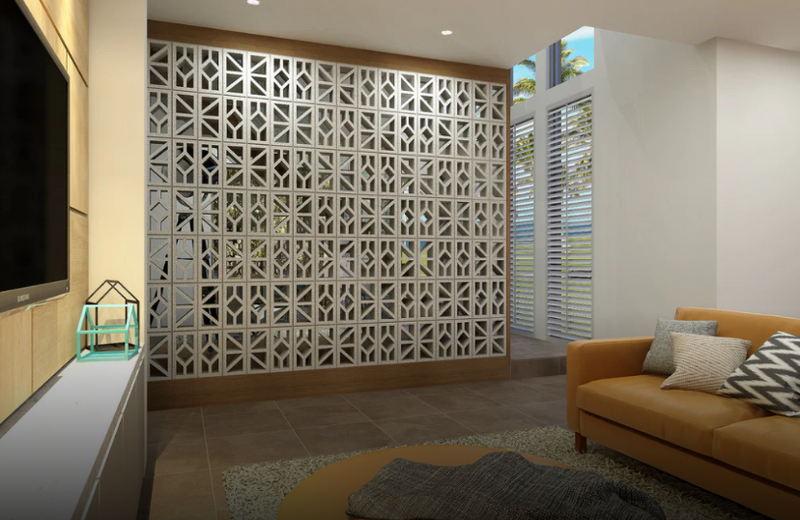
Breeze blocks are decorative masonry units with geometric cut-outs that let light, air and sight lines pass through a wall without sacrificing privacy or structure. Originally popular in mid-century Australian homes, they've made a strong comeback in contemporary residential and landscape design — used for pool surrounds, entry screens, garden walls and outdoor entertaining areas. They're non-structural in most applications, set in mortar the same way as standard block, and available in a range of patterns from classic lattice to bold architectural geometries.
Explore our feature wall range for use in landscape design and exposed interior brickwork.

Costs and Delivery Factors
Concrete block pricing is driven by four things: block format, manufacturer, order volume and freight. As a guide, a standard 200 series grey hollow block sits in the lowest tier, with coloured architectural blocks and decorative breeze blocks at a meaningful premium. Freight is a bigger component than buyers usually expect, because blocks are heavy and palletised, the further a site sits from the manufacturing plant, and the harder the access at the unload point, the more the delivered cost climbs.
Pallet quantities and unloading
Manufacturers ship blocks on factory pallets, generally 70 to 80 hollow blocks or 90 to 100 solid blocks per pallet. Most of our block deliveries across Brisbane, the Gold Coast, the Sunshine Coast and into Sydney run on flatbed trucks with onboard crane (HIAB) unloading, with pallets set as close as the crane can reach to where the blocks will be laid. Sites that can't take a HIAB drop will need a forklift on site, hand unloading, or pallets broken down across smaller deliveries, delivery and access details are worth confirming before booking. Any council requirements block walls might trigger should also be sorted before materials arrive: engineer-certified designs are generally required for walls over 1 metre, and most local councils across south-east Queensland and Sydney also have setback and stormwater rules that catch DIY builders by surprise.
READY TO ORDER?
Bricks Blocks Pavers Online was founded with a mission to provide builders, tradies, and DIY enthusiasts across Australia with the highest quality blocks.
-
Premium Quality
Our blocks are sourced from leading manufacturers, ensuring long-lasting durability and exceptional performance.
-
Expert Advice
Our knowledgeable team of building professionals is always on hand to provide tailored guidance for your specific project.
-
Fast & Reliable Delivery
We pride ourselves on our efficient delivery network, ensuring your bricks arrive on time, every time.
-
Competitive Pricing
We offer our blocks at competitive prices without compromising on quality.


EMBRACING BLOCKS: INSIGHTS & HOW-TOS
-
 | 5 mins read
How To Build a Block Retaining Wall (Step-by-St...
A retaining wall is one of the most useful structures you can add to a sloping block, holding back soil, creating level ground, and turning an awkward slope into usable...
-
 | 5 mins read
Besser Blocks vs. Bricks: When to Use Each Mate...
Besser blocks and bricks both turn up on building sites across Australia, but they're built for different jobs rather than competing head to head. Picking the wrong one can add...
-
 | 5 mins read
How Many Bricks Do I Need? Calculator & Estimat...
Getting the numbers right is one of those jobs that's easy to put off and easy to get wrong. Order too few bricks and the job stalls while you wait...


